Photography ... astronomy ... art ... design ... technology
(... and the odd rant)

All of these make my world go 'round, to some extent, and they will all be found here at some time or other. Some of the photography can be purchased from my Redbubble site. I can also be found at Tempus Fugit (no longer being updated).
Showing posts with label astronomy. Show all posts

Wednesday, November 4, 2015

Yet more kitchen capers

Occasionally, when either necessity dictates or the mood takes me, I set to in the kitchen, and concoct something that I hope will be edible. I dislike using recipes, so tend to either stick with standards (meat, veg and multi-ingredient mash; fish and whatever; bolognese, con carne, or just stuff mixed and cooked in whatever time-honoured fashion is appropriate... you get the picture) or invent something as I go. The latter can be a risky venture, leading to unpalatable or just disappointing results, but thankfully I can usually pull off something worthwhile.

Tonight, I fancied something inspired by a simple rice-and-lentils meal we enjoyed with friends years ago, when we dropped in with little warning. It was tasty and simple, and despite their disclaimer that it was nothing special, I liked it very much. Why I should wait 22 years to attempt something similar is beyond explanation.

Here's the gist of it:

Lentils with rice and vegetables

• 1/4 cup green lentils
• 1/4 cup brown lentils
• 1 cup rice and ancient grains (or just brown rice)
• 1 onion, chopped
• 1 carrot, grated
• 2 cloves of garlic, mashed
• a dozen or so round beans, chopped
• 1/2 small red capsicum, chopped
• handful of cherry tomatoes, halved
• 1 can chopped tomatoes
• small amount of chopped salami, cabanossi, etc, if desired (I desired)
• sprinkle of basil and oregano

Simmer lentils for about 10 minutes, then top up with cold water, add rice and simmer for another 20-30 minutes or until cooked.

Saute onion until soft, then add garlic for a minute or so. Add carrot, beans, capsicum, chopped tomatoes and herbs (and meats if used), and simmer while rice & lentils are cooking. When all is nearly done, add cherry tomatoes and simmer for another 5 minutes or so.

Drain rice & lentils when ready, rinse with hot water, and add vegie mixture with salt & pepper to taste.

If daughter is not eating with you, add mushrooms to the vegie mix, or anything else that she would otherwise object to.


It was scoffed satisfactorily, and Young Man of item-with-daughter status ate his before leaving the kitchen, then obliged with preventing a leftovers situation from arising.

It's what's called a result, I believe.

There was no photograph, so here's something completely different.


Lunar occultation of Saturn, 14 May 2014

Tuesday, October 20, 2015

Waxing

A bright, clear crescent Moon did shine down last night, and with a young man interested in seeing through the big scope, I stirred myself to grant his wish. While looking at the ancient surface, I noticed that the seeing was pretty good, so got the camera mounted for a few snaps.

There's nothing groundbreaking about a pic of the crescent Moon, of course, but it's always pleasing and never looks the same twice—unless you wait a long time and look at every possible opportunity. On this occasion though, there was a pinprick of light inside a large crater, evidence of day breaking upon a central mountain peak ... and who doesn't like a mountain sunrise?

The telescope is effectively acting as a 1200mm f8 long lens, which is pretty big on a crop sensor camera (Canon 40D). At ISO-400, the exposure would be reasonably short, except that I wanted to make the most of that little sunlit mountaintop, so took exposures of 1/13, 1/25, 1/50, 1/100 and 1/200 second, to get detail in both highlights and dark areas near the terminator (the day/night boundary). I then combined all 5 exposure levels to make an HDR image.

The southern highlands, at top, appear more heavily cratered as they haven't been overlaid with lava,which process produced the dark 'seas' in the northern hemisphere.
 
Maurolycus, with central peak lit

The crater trio Catharina, Cyrillus and Theophilus, beside the Sea of Nectar
 
Sea of Tranquility; Apollo 11 site circled


Wednesday, April 23, 2014

Nocturnal lunacy

Time was, we counted the passage of time in Moons. It's a convenient measure: short enough that one is 'only recently' but long enough that a dozen or so will take you through a set of seasons. 'Moons' in this context, means lunar months—or more specifically, the synodic months from New to Full and back again to New; a period of 29.5 days. (The other lunar month is the sidereal one, when the Moon returns to approximately the same position among the stars.)

The Moon is endlessly fascinating. Whether you are watching a Moonrise over the bay with nothing but your eyes (and possibly a glass of something convivial), or you are studying it at high magnification through a large telescope under a crystal-clear dark rural sky, it has a universal appeal.

For my part, I have watched with telescope and without; with binoculars; with camera; and with all sorts of permutations thereof. I have watched its phases come and go. I have watched the Sun's light slowly creeping across that distant landscape, illuminating crater floors and mountain peaks: a constantly-changing chiaroscuro that Buzz Aldrin described from its surface as 'magnificent desolation'.

Purbach, Arzachel & the Straight Wall


In 1976 I was given a second-hand 6-inch (150 mm) reflecting telescope. I had arrived. At last, I had an instrument with a proper mount, driven to follow the movement of the stars (actually, the rotation of the Earth, but let's not quibble), with which I could employ substantial magnification upon celestial sights near and far. By that time I had already decided that I needed to learn about photography, so that I could record what I was seeing through the eyepiece. Little did I know the challenge ahead...

I did try to mate my somewhat ancient SLR camera to the telescope, trying to get decent photographs of Moon and planets, but the results were generally disappointing. Fuzzy, shaken images discouraged me and until I was introduced to the Thomas Cooke 6-inch photovisual refractor at the City Observatory in Edinburgh, I did no more telescopic photography. The Cooke was a fine instrument in a poor situation. Murky city skies and poor 'seeing' were constantly conspiring to reduce image quality, but I did dabble a bit, and even recorded the second Scottish image of Comet Halley with it in 1985.

Copernicus, Eratosthenes & Appenines


I have the good fortune these days to work at the Sir Thomas Brisbane Planetarium, which is equipped with a Zeiss 150 mm refractor. The beauty of that instrument is that it sits on a coudé mount, which means that the viewing end doesn't move with the telescope, which in turns allows any camera to be mounted without upsetting the balance. The drawback to this telescope is its optical system: as an ordinary 'achromat', it is subject to incompletely-corrected colour, so that when taking photographs there tends to be a blue haze around bright objects. (The Cooke, with a 'photovisual' triplet objective, was corrected for red, green and blue light.) So, after trying for a while to take some decent lunar photographs through the Zeiss, I find that unless I want to discard the blue channel and go for a greyscale image using just the red and green, it's of limited use. Which is where I come back to the old reflector (the 'CF', it having been manufactured by the old Charles Frank company in Glasgow).


The Zeiss refractor, with Yours Truly observing the Moon.


The reflecting telescope was devised by Isaac Newton as an alternative to the simple lens telescopes of the day, which were even more plagued by false colour than any modern achromat (a-chromat ... meaning no colour, but they don't quite live up to that name). I'd never achieved much with mine in the past, but would a modern digital camera make any difference?

One of the great benefits of digital imaging is the immediacy of it: you can see the image without waiting for a film to be processed and printed. So, when you need to assess the accuracy of focus, exposure or subject targeting, you have almost instant feedback. If the camera has live view focusing then the focus can be refined before shooting, under high magnification (although even then, checking the images on a large monitor allows a final decision).

Fortunately, the image scale of the CF is almost perfect for a crop frame DSLR: the Moon sits comfortably in the frame, while allowing some room to move; it's effectively a 1200mm long-focus 'lens'. I have become enamoured of hitching my Canon 40D to it, and recording our nearest natural neighbour, although it's hardly ground-breaking stuff. No two images will be the same though, due to the changing phase and libration—the apparent east-west and north-south wobbling that allows us to see 59% of the lunar surface (even though the Moon keeps nominally the same face to us all the time).

Here then is a set of images taken over the last month or so, as well as a 3D stereo pair using another image from last year. Enjoy.


 The Moon's size varies because of its elliptical orbit. A so-called 'supermoon' is a Full Moon when it's at its closest distance from Earth, although it's only about 14% larger than the opposite extreme.

Waxing and waning gibbous phases. The images have been processed to enhance the subtle colouration due to different mineral composition; the Sea of Tranquility is noticeably more blue than its neighbours.

 
The total eclipse of 15th April 2014. 5 minutes before the end of totality (left), and about 30 minutes later, in partial eclipse (right); the latter image has been HDR-merged from 3 separate exposures that cover the great brightness difference between the shadowed and sunlit portions.

A crescent Moon in two bites, showing the 'Earthshine' that brightens what would otherwise be the dark side.

It might just look like 2 Full Moon images, but this is a stereo pair. Try crossing your eyes, then bring the middle of 3 images into focus. If you can manage it, you should see a round Moon instead of 2 flat images.

Sunday, June 13, 2010

Back in the land of the living

It's been a while, and there's been a bit of water under the bridge since I last came this way. I've left behind the work of casual employment, and started a job for which I am eminently suited - which makes a change!

In April we relocated to Brisbane, so that I could take up a post at the Sir Thomas Brisbane Planetarium. There, I am styled a Support Officer, which means I am one of the show presenters. School shows, public shows, observatory sessions - they're all in the mix, as I show the good citizens and tourists of Brisbane the sights of the night sky and the Universe at large.

There is a certain repetitiveness about it, giving the same shows on a weekly basis, but with the changing sky as the year progresses, and the different audiences from 5-year-olds to adults, there is a certain amount of freedom to ad lib in each show and change the focus along the way. Besides, there is an awful lot of Universe to talk about in a 15- or 45-minute talk.

One of the fringe benefits for me as a long-time amateur astronomer, is having access to 2 good telescopes - a Zeiss 6-inch refractor and a Meade 8-inch Schmidt-Cassegrain. The pleasure is somewhat reduced due to the location just a few kilometres from the centre of a large city, but it's good to be back at the sharp end of a decent instrument. While in Edinburgh I had access to the Cooke 6-inch refractor at Calton Hill observatory, although I made far less use of it than I ought to have done, and really became an armchair astronomer over the last 20 years or so.

The Zeiss is particularly interesting, as I can easily mount a camera on it for photography through the telescope. So far I have just done a few tests that need to be built on, but I reckon I shall have fun with it in the future. As well as 'proper' photography with a camera attached securely to the business end (being on a Coudé mount, the scope can support quite a heavy load, which is just as well, since I intend to use my old brass Canons), I have experimented with cameras held against the eyepiece; not the best method, but it can work reasonably well, as this shot of Saturn taken with the mobile phone shows.

Another experiment was shooting both the Sun and Moon with a digital compact - still shooting precariously through the eyepiece while hand-holding the camera, but it worked quite nicely. 2 small sunspot groups are visible at top right and bottom right, and despite fairly poor seeing, the Moon image shows reasonable crater detail.


Thursday, April 16, 2009

Distant shadows

Astronomical imaging technology has come a long way since I first looked at Saturn through a small telescope, some time around 1973. Pioneer and Voyager spacecraft brought us the Ringed Planet from a vantage point outside of Earth's orbit for the first time, and presented breathtaking views of ring details, strange 'spokes', new rings and extra Saturnian satellites. Lately, Cassini has taking an extended look, and brought more detail and revelations, including a backlit Saturn with new, diffuse very faint rings much further out from the main rings.

Currently, Saturn's rings are being viewed almost edge-on to Earth and the Sun, which happens only twice in each 29-year orbit. When it does happen, we can see things that are normally hidden by the rings, such as some of the smaller satellites (and their shadows) passing in front of the giant planet. From the privileged vantage point enjoyed by Cassini, we are able to look down on the planet and its ring system, as in this image. As well as the sheer fascination of seeing such fine detail in the ring structure and the shadow of a satellite, there's a new treat: shadows from the rings themselves.

Jagged Shadows May Indicate Saturn Ring Particles

Much of the ring system seems to be composed of flat, uniform rings of differing width and brightness. Some rings are known to appear like twisted rope, and are separated from the main rings, as they are affected by small nearby satellites. In this case, we seem to be looking at a ring which is directly adjacent to others, but which seems to have definite thickness and texture, and which splits in two. The thickness is evident from the lumpy shadow cast on the other rings, and is a reminder that even with something as well-observed as Saturn, new surprises are still lurking.

Monday, July 28, 2008

Beautiful science

Science seems to elicit a range of reactions from people: excitement, fear, distrust, puzzlement, and so on. There are those who hang on almost every word that scientists utter, and those who are dismissive of scientific endeavour, and see it as evil work, just serving to ruin the world. Some of these reactions are understandable, given the range of effects and products that scientific discovery and progress has produced, both good and bad.

For some, science can be just plain beautiful; such beauty can lie in an equation, the proof of a theorem, or a truly captivating image generated by any branch of science capable of so doing. One such example of the latter is this delightful confirmation of one of Einstein's predictions - gravitational lensing. Put simply, gravity can bend light. It takes a massive object, with a substantial gravitational field, to achieve this, but fortunately, the Universe is full of such things.

Our Sun is massive enough to show the effect, which can be demonstrated during total eclipses: stars 'behind' the Sun (but close enough to it, in the line of sight) can be seen in slightly different positions than expected, due to the Sun's pull on the distant starlight. When we look deep into the Universe though, we can observe not just stars, but entire galaxies that give rise to this effect. Often, the result is fragmented arcs of light, as very distant objects are not just 'moved ' slightly, but completely distorted. One very fine example of the effect is in this image from APOD. A very distant galaxy has been distorted into a nearly complete ring, by a nearer one. Click the image to read more.

SDSSJ1430: A Galaxy Einstein Ring
Credit: A. Bolton (UH/IfA) for SLACS and NASA/ESA

Friday, June 13, 2008

3 Phases of The Moon

I've been taking photographs and stargazing for a long time; inevitably, those two pursuits cross paths now and then. It might be a startrails pic, a guided exposure of a comet, or something a bit more whimsical.

Delving into the archives, I took a moon photo from circa 1984, and played with it a bit to create this image. I'm not divulging the recipe, but you won't find it as a simple Photoshop tool! Actually, I'd probably find it difficult to reproduce myself; sometimes I 'explore' an image, making derivative copies, modifying and combining them in different ways until I create something that looks a bit interesting. Usually, I leap rapidly from one transformation to the next, without recording exactly what I've done, so the end result is usually unreproducable. One such exploration, that I didn't save in the end, produced some images that looked like an aged Daguerreotype, and to some extent I was trying to recreate that here.


Click the image to buy from Redbubble
(Available as a card, laminated print, matted print, and more)


Monday, December 10, 2007

Obsession

I've been away, speaking figuratively. Same desk, same PC, different bit of cyberspace. RedBubble, it seems, is somewhat addictive. However, I do have a life beyond it, and part of that life encompasses astronomy from time to time.

In doing a bit of research for a talk last week, I came across
Galazy Zoo. This is an online project that encourages people to assist with the massive task of classifying distant galaxies. As the site says, it's a: "project which harnesses the power of the internet - and your brain - to classify a million galaxies. By taking part, you'll not only be contributing to scientific research, but you'll view parts of the Universe that literally no-one has ever seen before and get a sense of the glorious diversity of galaxies that pepper the sky."

Well, I just went back to that site to look a bit further, and ended up registering. That process led me very quickly through the tutorial & test, and straight on to the work itself. No fuss, no ceremony, no tedious application or PhD thesis, just lots of pictures, as fast as I could work through them. And therein, I think, may lie the success of this project: as soon as you've done one, another image appears. Well, you can't possibly leave that one, so you do it. Then, there's another - which will only take a second or 2 - and then ... and so on. Oh, go on, just one more, it might be an interesting one. Here's a screen grab:


And so, obsession rears its ugly head once more. Have a go, you might enjoy it!

Thursday, November 15, 2007

Twinkle, twinkle

Sitting in the car tonight, waiting for my daughter, I opened the window and looked skyward. A beautiful night, warm, with as many stars as one would expect, this close to a sizeable regional town, and a crescent moon high in the west. A typical scene, yes? Well, it is here, Down Under (notwithstanding the wet season's first substantial cloud-bounty). However, I was taken back to my first experience of Australian skies, after first arriving here from Scotland 20 years ago. I was captivated. Not surprising, giving that I'd left a freezing northern land in January, complete with snow-turned-to-ice on the ground, and embarked on a delightful sojourn (it was supposed to be work, but was too much fun for that to be relevant) to the sub-tropical antipodes.

From 0° C to 40° C in the space of about 5 days, was quite a change. Temperature is just physics though; it required some adjustment, but it was what it was: hotter than I'd ever imagined. The sky however, was something else. Seeing Sirius nearly overhead, its brightness undimmed by the low altitude of a Scottish viewpoint, was the first thing of note. The second remarkable thing was that this scene was to be observed night after night - such that, after 2 months of unremitting sunshine and blue Rayleigh scattering, I was delighted to see a cloudy sky for a change. Anyone accustomed only to the perpetually grey skies of Britain would probably find that hard to imagine...

Back to tonight: it's easy to become blasé about the beauty of the sky, when it's always there, being ... beautiful. And even as an amateur astronomer of some 35-40 years, I am as affected by that as anyone else, and need to take a longer second look sometimes. Having said all that, what appeals so much about the night sky here - at least, between spring and autumn - is the fact that the whole experience is so damed comfortable. I don't have to put on 3 inches of insulation, before heading out to discover that it has now clouded over. There is such a sense of blissful relaxation to be had, looking at distant beacons gliding ever so slowly overhead, while crickets, cicadas etc sing their song.

I have to admit though: I'd exchange a few of these balmy, almost unchanging nights for a few displays of aurora under a crisp heaven with fiercely-twinkling stars. Of all the sights in nature, there can be few as awesome as the northern (or southern) lights. With that thought, here's a pic taken some years ago: a green rayed band over the orange glow of Edinburgh. It's a sight I will never tire of.

Image copyright © Duncan Waldron, 1992. All rights reserved.

Saturday, October 6, 2007

Comet Encke fishtailing across the sky

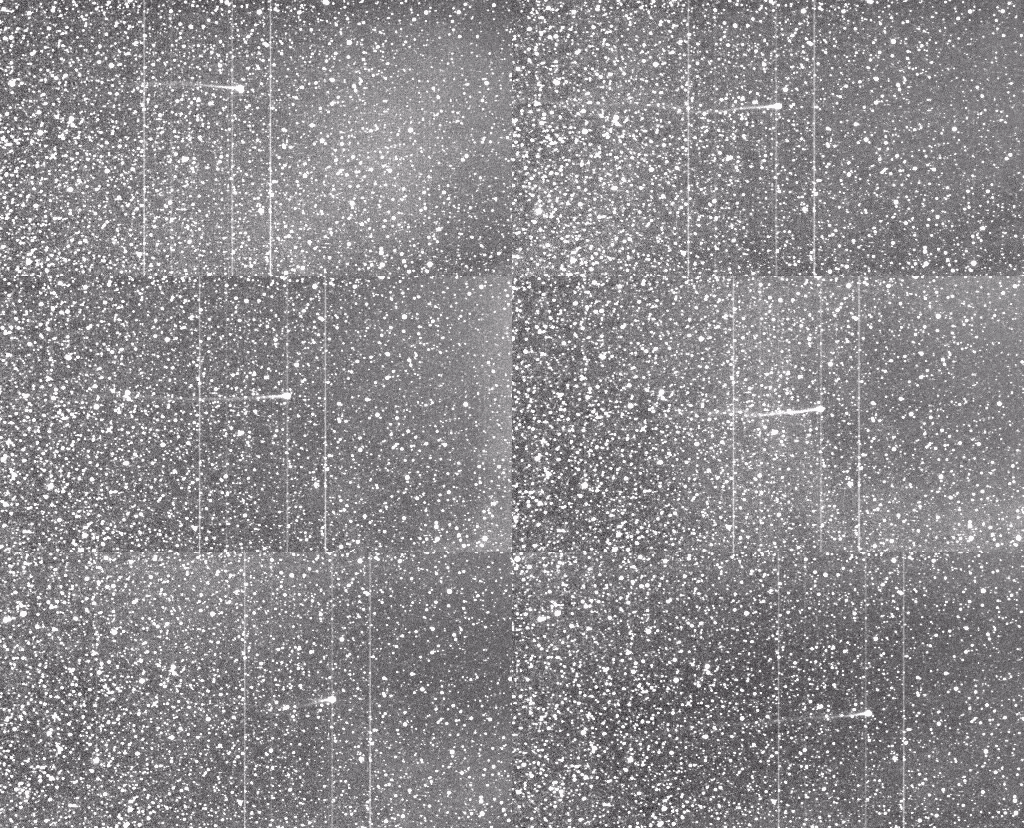
In this delightful time-lapse image from NASA's Astronomy Picture of the Day, the tail of short-period comet Encke can be seen flailing about in the solar wind.


Go to
http://apod.nasa.gov/apod/image/0710/enckeRipoff_movie_short.gif for the animation. The comet is small (it orbits the sun about every 3 years, so has lost a lot of its mass over time), but the sequence is quite fascinating – normally, a comet is so slow-moving that you need to watch carefully for hours or days, to see any change. On this occasion, the wonders of time-lapse have saved you the wait.